Tuesday, 24 July 2012

Batch cooking for baby: Lasagne


My lasagne is okay. Not great or amazing, but okay. I'll post the recipe below, but I thought I'd take the opportunity to link you to Felicity Cloake's Perfect... series that she writes for The Guardian. Ms. Cloake takes a classic recipe and compares versions from across the world, and, perhaps more interestingly, from different food writers. Even if you don't like the original, it makes for fascinating reading.

So, back in November 2010, Ms. Cloake wrote about the Perfect Bolognese. Apparently, white wine, not red, chicken livers and milk are key ingredients for bolognese sauce.

I have always made my sauce for bolognese and lasagne in exactly the same way. However, in November 2011, Felicity experimented with the various components which make up the Perfect Lasagne. Here, she found that red wine, rather than white, was important, and, interestingly, a white bechamel, with parmesan added on the top, were the keys to the perfect lasagne. The chicken livers stayed. I have to admit, I haven't tried making either bolognese sauce or lasagne with chicken livers yet.

This is what I would call an 'everyday' lasagne. Lasagne is a brilliant family dish, and pretty much guaranteed to make my husband happy, if it's served alongside some salad and perhaps some ciabatta bread. However, an authentic lasagne takes hours to cook, and I didn't have that much time. This probably takes about an hour, start to finish.

My Lasagne Recipe


Ragu sauce
1 carrot
1 onion
1 stick of celery
2 tbs Olive oil
3 cloves garlic
500g minced beef
3-4 rashers bacon
1 tbs tomato puree
2 tsp Italian herbs
Optional: Mushrooms and peppers if you want to up the vegetable content
2 tins tomatoes
Red wine if you have it
Worcester sauce
Seasoning

Bechamel Sauce
50g butter
50g plain flour
600ml milk
Nutmeg
200g Cheddar cheese or a mixture of cheddar and parmesan

9-10 sheets of dried lasagne pasta

1. Chop the carrot, onion and celery very finely. Fry in olive oil gently in a large saucepan, to soften rather than colour. Add the garlic, crushed. When the vegetables are starting to soften, add the minced beef in small pieces, allowing them to break up and brown. Add the bacon, chopped into small pieces. Add the tomato puree and italian herbs and stir well. At this point, if you want to add mushrooms and peppers, chopped fairly small, do so.

2. Add the tinned tomatoes to the saucepan, along with 100ml of red wine, and worcester sauce to taste. Season generously, and let simmer while you get on with the bechamel sauce.

3. Melt the butter in another saucepan over a medium heat. When it has melted, turn the heat down, and whisk in the flour. When the butter and flour are smoothly combined, add in the milk, gradually, and whisking all the time. When all the milk is incorporated, turn the heat up and bring to the boil, allowing the mixture to thicken. Keep whisking all the time to avoid any lumps. Grate the cheese and stir it inot the sauce. Grate some nutmeg over the sauce.


4. Arrange the lasagne in your dish. The best way I have found is to have a third of the meat sauce, then a layer of pasta, then a layer of the white sauce. Repeat this, so that you have a layer of sauce left over at the end to finish it off. 


5. Bake in an oven at 200 C for around 40 minutes. Serve with salad and ciabatta bread.


Freezing notes: I assembled this in 3 small dishes and cooked them for around 20 minutes each. To cook for eating, defrost and then cook in a hot oven for 25 minutes.

Thursday, 5 July 2012

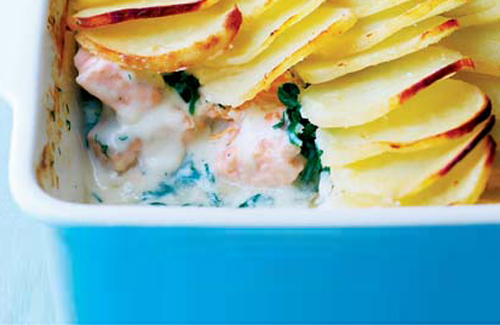
Batch cooking for baby: Salmon and Dill Potato Bake


We're expecting a baby in August. We're also having our kitchen completely redesigned and re-fitted. All of this upheaval, not surprisingly, turns my mind to meals. I'm quite good at meal planning now, but I also know how invaluable it can be to have something convenient stashed away in the freezer, ready either to be cooked from frozen, or defrosted without any additional preparation needed.

I've done a fair amount of cooking now, and the freezer is gradually being stocked up. So I thought I'd collect some of these recipes together.

This was adapted from a recipe from deliciousmagazine.co.uk, and the first batch was absolutely delicious.

Salmon and Dill Potato Bake


Ingredients:

4 skinless salmon fillets
600g potatoes
200g baby spinach
1 onion
1 lemon
50g butter
50g flour
500ml semi-skimmed milk
15g dill

Method


Peel and slice the potatoes. Put them in a large saucepan of cold water and bring to the boil. Allow to boil for 10 minutes. Drain and set to one side.

Chop the salmon fillets into small chunks. Chop the onion, and combine in a bowl with the salmon. Wilt the spinach, by pouring boiling water over a colander full of the spinach. Drain well, and add to the salmon and onion. Zest and juice the lemon and add to the salmon mixture.

Make a white sauce, by melting the butter and then whisk in the flour. Cook for one minute, stirring well. Gradually add the milk a little at a time. Bring to the boil, whisking, and allow the sauce to thicken. When the sauce has thickened, add the dill, finely chopped.

Pour the sauce over the salmon mixture and stir gently to combine. Transfer to an ovenproof dish - I used the foil take-away style dishes from the supermarket.

Layer the potatoes on top of the salmon mixture. You can freeze the dish at this point. To cook, make sure the bake is thoroughly defrosted, and dot the potatoes with butter. Bake in a preheated oven at 200C, for 45 minutes, or until piping hot throughout.

Friday, 24 February 2012

Gardening Dreams

Yesterday was a really beautifully warm day. I've designed my garden plan, ordered my seeds and a brand new windowsill propagator, and I couldn't wait to get started. Except... my seeds haven't arrived yet.

Nevertheless, there were still signs of Spring all around.

The chives were springing up, and the parsley has miraculously survived the winter!


Crocuses were opening in the flower bed and tulips were pushing up their green spikes.


Another winter miracle, my Romanescue broccoli, seems to be producing a flower head. It did nothing all last Summer, and I was too lazy to dig it up. Do I dare home my laziness might reward me?

 The Swiss Chard is coming back to life after the frost.
 And the rhubarb is pushing through! I had to search hard for this one!

Thursday, 23 February 2012

Cookie Monster Cupcakes

It was my husband's birthday yesterday. Last week, he sent me an email, with a birthday request: Please could I have these for my birthday? He'd found a photo of cookie monster cupcakes on the Internet, and thought they were the coolest cakes ever.

It so happens that his birthday coincided with my half term, so I have had some extra baking time this week. So I spent some of this time making the requested cupcakes.

The recipe starts, confusingly, with the decoration. I melted white chocolate and dropped it onto parchment paper to make the eyes. When these were set, I then melted dark chocolate and dripped it onto the eyes. I then dyed some coconut (approximately 200g at a guess) blue with food colouring. I spread this out onto a tray on greaseproof paper to dry.

For the sponge cupcakes, I used the recipe here: http://www.bbcgoodfood.com/recipes/470636/lemon-and-poppyseed-cupcakes, which uses natural yoghurt. I'm not sure about the science of it, but they taste really good, although I omitted the poppyseed. I didn't think they would work with the coconut.

When the cakes had cooked and cooled, I used more blue food dye (to make 12 cupcakes, I used 3/4 of a bottle) to dye some buttercream icing.

The comes the tricky bit: the assembly. You spread the icing onto the cupcakes, quite thickly. Then, working quickly, you turn each cupcake over and dip it in a bowl of the blue coconut, so that it sticks to the icing. When I had done this, I put them into the fridge to cool and set a bit. Then you need to cut a mouth out - and I needed to actually remove a chunk of cake. I halved some smallish chocolate chip cookie biscuits, trimming off the edges to get them into the mouths, and stuffed these into the cookie monster mouth. Finally, I placed the eyes on, making sure they were suitably wonky.

Friday, 20 January 2012

Sourdough


I have been planning to make Sourdough bread for a very long time. You read so much about it, about its wonderful, chewy texture, its delicious taste... and you can't buy it anywhere near here. So when Head of Bread announced on 1st January that he was going to tweet instructions for making a starter, I was definitely up for joining in.

The first stage is to mix together flour (I used wholemeal throughout) and water, and he suggests adding in three raisins to kick-start fermentation. I did this, and left it on the worktop overnight. The following day, I added more flour and water, and there were definite bubbles. I repeated this process for two weeks, mostly adding flour and water (known as feeding) every day, although sometimes every other day.

Then we were told to put our starters into the fridge.

"The fridge?" We all cried (tweeted). Yes, we were told, for the fridge would not kill our starters, only slow them down.

Well, I was not quite ready for baking, so my starter went into the fridge.

The following week, I had to "wake up" my starter, by feeding it and leaving it out of the fridge overnight before I baked with it. It was showing all the signs of fermenting, and on Saturday, I followed the baking instructions. This included kneading for 20 minutes. As a novice kneader, I struggled with this, but eventually achieved the required texture. I left it to prove, knocked it back, proved and shaped over the next 12 hours. Then I went to bed.

The loaves were cooked the next morning, following tips from Dan Stevens - oven on its highest setting, tray of boiling water at the bottom to create steam - and the loaves did bake. They tasted delicious - slightly tangy, and definitely tasty. But the texture was just too dense. I don't know if it was the proving, the kneading, or the 100% wholemeal flour, but it wasn't the best bread.

The starter is still alive and bubbling, although it is back in the fridge. Next weekend I'll have another go, and see if white flour is the way forward. The picture is not mine, but is very close to how mine looked.

Thursday, 27 October 2011

Blueberry Muffins

I don't make muffins that often, but I think I should. Mostly because they're so easy. They're a good gift, and I was visiting a friend who has a new born baby this afternoon, so I took her half the batch of muffins. I don't think muffins keep well, so it helps if you give half away - otherwise I feel obliged to eat them all.

Making muffins is unlike any other kind of baking I've really done. The butter (75g) is melted, left to cool a little, and then mixed with yoghurt, milk (100 ml of each) and an egg. In a separate bowl, you mix 200g plain flour, 2 tsp baking powder, 1/2 tsp bicarbonate of soda, a tsp of salt and 75g caster sugar. Then you mix the two mixtures - wet and dry - together, before stirring through 200g blueberries.

I know they'll never be as dome-topped as the ones you get at Starbucks, but they're delicious.


I have to confess this picture isn't mine - my camera battery has died today - so it's from womentribe.com.


Monday, 24 October 2011

A different kind of wedding cake

Back in January, my friends Becca and Jon Man got engaged. They decided that they didn't want a traditional wedding cake, mostly because Jon Man could stand the imagery of it. So they decided to do something rather unusual with their cake.

They got together a list of all the different kinds of cake they had enjoyed, together and separately. Next, they asked several of their baker friends if they would mind baking one or two of the cakes. On the day, these cakes were assembled on to vintage cake stands, and a selection was handed to each table, afternoon-tea style, in place of dessert.

Now, I know that afternoon tea is a very on-trend theme for weddings, but I have certainly never been to a wedding where they were served just like this. Becca had even made a little booklet describing each cake and why it was important to her. It was a really lovely touch.


The cakes were:

Chocolate Fudge
Amazing Chocolate Cheesecake
Chocolate Torte
Lemon Drizzle Mash Cake
Apricot Fruit Cake
Carrot Cake
and, of course, scones.